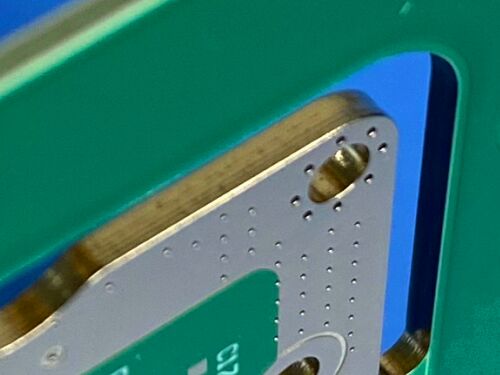
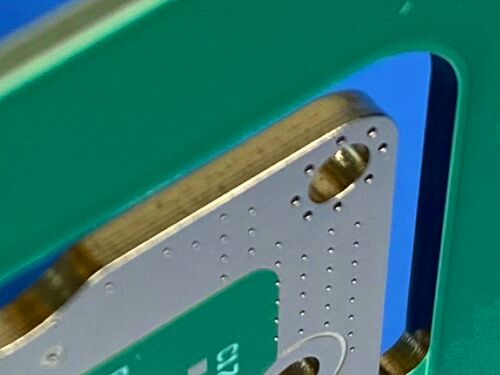
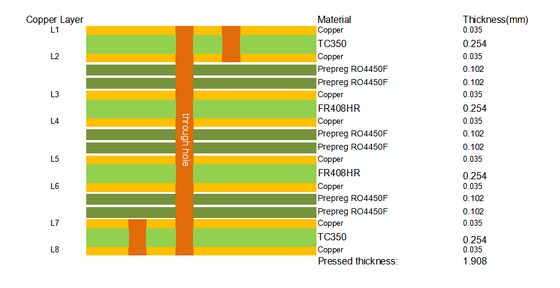
Ce PCB est une construction en cuivre à 8 couches, adoptant une combinaison de matériaux haute performance et des normes de fabrication strictes pour répondre aux exigences des applications électroniques à haute fiabilité. Il comprend des vias remplis de résine et recouverts, un placage de bord (enveloppement métallique du bord), une finition de surface en or par immersion et un masque de soudure vert avec sérigraphie blanche, garantissant une excellente intégrité du signal, des performances thermiques et une robustesse mécanique.
Spécifications de base du PCB
| Paramètre de construction |
Spécification |
| Matériau de base |
Préimprégné TC350, FR408HR, RO4450F |
| Nombre de couches de cuivre |
8 couches |
| Poids du cuivre |
1 oz par couche |
| Épaisseur de la carte finie |
2,0 mm |
| Dimensions de la carte |
99 mm × 83 mm |
| Finition de surface |
Or par immersion (ENIG) |
| Masque de soudure et sérigraphie |
Double face : masque de soudure vert et sérigraphie blanche |
| Configuration des vias |
Vias borgnes ; vias de 0,2 mm avec remplissage de résine et capuchon par galvanoplastie (via rempli et capuchon) |
| Caractéristique spéciale |
Placage de bord (enveloppement métallique du bord) |

Introduction au matériau TC350
TC350 est un composite de substrat de PCB à base de PTFE, renforcé de fibre de verre et rempli de céramique, offrant une conductivité thermique exceptionnelle (1,0 W/mK) qui améliore le transfert de chaleur, réduit les pertes diélectriques et d'insertion, et augmente le gain et l'efficacité des amplificateurs/antennes. Il gère une puissance plus élevée, minimise les points chauds et convient aux applications avec une gestion thermique limitée.
Les stratifiés TC350 maintiennent une excellente stabilité de la constante diélectrique (-9 ppm/°C) sur une large plage de températures, ce qui est essentiel pour les amplificateurs de puissance, les antennes et les dispositifs sensibles à la phase/à l'impédance. Son faible CTE en direction Z correspond au cuivre (assurant la fiabilité des trous métallisés) et, en tant que "substrat souple", il résiste aux vibrations/chocs pour répondre aux normes de test de chute.
Il adhère fortement au cuivre à profil bas de qualité micro-ondes (pas besoin de "cuivre dentelé"), réduisant encore les pertes d'insertion aux fréquences RF/micro-ondes élevées. Rentable pour un usage commercial, il est plus facile à percer que les stratifiés traditionnels et présente une résistance au pelage élevée pour une adhérence fiable du cuivre dans les environnements soumis à des contraintes thermiques.
Caractéristiques et avantages clés du TC350
-"Meilleure en classe" conductivité thermique (1,0 W/mK) et stabilité de la constante diélectrique sur une large plage de températures (-9 ppm/°C)
-Tangente de perte très faible, offrant une efficacité d'amplificateur ou d'antenne plus élevée
-Rentable pour les applications commerciales
-Plus facile à percer que les stratifiés commerciaux traditionnels avec du verre tissé épais et dense
-Résistance au pelage élevée pour une adhérence fiable du cuivre dans les applications soumises à des contraintes thermiques
-Excellente dissipation de chaleur et capacités de gestion thermique
-Efficacité de traitement améliorée et fiabilité globale
-Disponible en grandes tailles de panneaux, permettant plusieurs tracés de circuits pour réduire les coûts de traitement
Applications typiques du TC350
-Amplificateurs de puissance, filtres et coupleurs
-Amplificateurs montés sur tour (TMA) et amplificateurs de puissance montés sur tour (TMB)
-Antennes soumises à des cycles thermiques sensibles à la dérive diélectrique
-Combinateurs micro-ondes et diviseurs de puissance
Introduction au matériau FR408HR
FR408HR est un système de résine FR-4 haute performance avec une température de transition vitreuse (Tg) de 230°C (DMA), spécifiquement conçu pour les applications de PCB multicouches nécessitant des performances thermiques et une fiabilité maximales. Fabriqué avec le système de résine multifonctionnelle haute performance breveté d'Isola, renforcé de tissu de verre de qualité électrique (E-glass), FR408HR offre une amélioration de 30 % de l'expansion dans l'axe Z et offre 25 % de bande passante électrique supplémentaire (perte plus faible) par rapport aux produits concurrents de la même catégorie.
Le matériau présente une résistance à l'humidité supérieure pendant les processus de refusion, comblant le fossé entre les exigences de performance thermique et électrique. FR408HR est fluorescent aux lasers et bloque les UV, garantissant une compatibilité maximale avec les systèmes d'inspection optique automatisée (AOI), les systèmes de positionnement optique et l'imagerie de masque de soudure photo-imageable. Il est entièrement conforme RoHS et offre une excellente compatibilité de traitement avec les processus de fabrication FR-4 standard, ce qui le rend facile à intégrer dans les lignes de production existantes.
Applications typiques du FR408HR
-PCB multicouches nécessitant des performances thermiques et une fiabilité élevées
-Applications d'assemblage sans plomb
-Appareils électroniques avec des dispositions de composants denses (capacité de pas de 0,8 mm)
-PCB nécessitant une compatibilité AOI et une imagerie précise du masque de soudure
-Systèmes électroniques haute fiabilité soumis à plusieurs cycles de refusion
Qu'est-ce que le remplissage et le capuchon de vias (remplissage de résine et capuchon par galvanoplastie) ?
Le remplissage et le capuchon de vias, également connu sous le nom de remplissage de résine et capuchon par galvanoplastie, est un processus de fabrication de PCB spécialisé conçu pour améliorer la fiabilité et les performances des vias, en particulier dans les applications à haute densité, haute vitesse et haute fiabilité. Ce processus implique deux étapes clés : le remplissage de résine et le capuchon par galvanoplastie.
Premièrement, les vias (dans ce PCB, des vias borgnes de 0,2 mm) sont remplis d'une résine isolante résistante aux hautes températures. La résine remplit entièrement le trou du via, garantissant qu'il n'y a pas d'espaces d'air ou de vides, ce qui empêche l'absorption d'humidité, réduit les interférences de signal et améliore la résistance mécanique du via. La résine utilisée est généralement compatible avec les températures de stratification et de refusion des PCB, maintenant la stabilité pendant les processus de fabrication ultérieurs.
Après le durcissement de la résine, la deuxième étape, le capuchon par galvanoplastie, est effectuée. Une fine couche de cuivre (ou un autre métal conducteur, correspondant à la finition de surface du PCB - or par immersion dans ce cas) est galvanoplastiée sur le via rempli de résine, formant un capuchon lisse et plat, à fleur de la surface du PCB. Ce capuchon protège la résine contre les dommages pendant l'assemblage, assure la continuité électrique (si nécessaire) et fournit une surface plane pour le montage des composants, ce qui est crucial pour les conceptions de PCB à haute densité avec des composants à pas fin.
Les principaux avantages du remplissage et du capuchon de vias comprennent : la prévention du mèche de soudure dans les vias pendant l'assemblage, la réduction de la réflexion du signal et de la diaphonie dans les applications à haute vitesse, l'amélioration de la conductivité thermique, la protection des vias contre les facteurs environnementaux (humidité, poussière) et l'amélioration de la robustesse mécanique globale du PCB.
Le rôle du placage de bord (enveloppement métallique du bord)
Le placage de bord, également appelé enveloppement métallique du bord, est un processus de fabrication de PCB qui consiste à plaquer les bords exposés du PCB avec un métal conducteur (généralement du cuivre, suivi de la même finition de surface que le PCB - or par immersion dans ce cas). Ce processus joue un rôle essentiel dans l'amélioration des performances, de la fiabilité et de la fabricabilité du PCB, avec les fonctions clés suivantes :
Amélioration de la mise à la terre et du blindage EMI : le placage de bord forme un périmètre conducteur continu (cage de Faraday), améliorant l'intégrité de la mise à la terre, réduisant les EMI externes et empêchant le rayonnement de signal interne, ce qui est essentiel pour les applications à haute vitesse, RF et micro-ondes nécessitant une intégrité de signal supérieure.
Résistance mécanique améliorée : il augmente la robustesse mécanique du PCB, résistant à l'écaillage des bords, aux fissures et aux dommages pendant la manipulation, l'assemblage et le fonctionnement, particulièrement adapté aux environnements difficiles ou soumis à de fortes contraintes.
Dissipation thermique améliorée : en tant que voie thermique supplémentaire, il dissipe la chaleur des composants, optimise la gestion thermique, réduit les températures de jonction et prolonge la durée de vie des composants.
Continuité électrique facilitée : il permet la continuité électrique inter-couches, simplifie la conception de la mise à la terre, assure des performances constantes et réduit la résistance des bords pour améliorer l'intégrité du signal.
Soudabilité et assemblage améliorés : sa surface conductrice lisse facilite la soudure des composants/connecteurs montés sur le bord, améliorant la fiabilité de l'assemblage et réduisant le risque de défaillance des joints de soudure.


 Votre message doit contenir entre 20 et 3 000 caractères!
 French